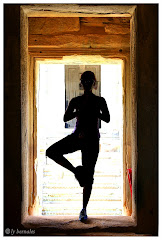
A lot of people have asked me what the difference is between yoga and other types of exercise – pilates, for example. Or stretching for that matter.
So here it is – the big answer (and it’s not really a big secret)
YOGA IS A WAY OF LIFE.
It is not profound as you might think it is. It is actually quite simple and very practical. Allow me to explain.
Yoga does not end when you step out of your mat. Yoga is what happens on and off the mat On the mat is where you focus and build your practice – but the basic principles of yoga apply in everyday life. Think of it in the same way that it is in church where you meditate, but it does not mean that you stop worshipping outside of the church , does it?
So, yoga is a lot like that. Practical applications that you take to your daily life.
Yoga has a lot of principles and different yoga practices might have different expressions of these principles. The Universal Principles of Alignment are principles taught by Ashtanga Practioners and governs the movement and the correct way of doing asanas. The concept of “kula” or community is also something that is founded on the Ashtanga teachings. Vinyasa yoga, on the other hand, talks about “flowing” into the poses and aligning breath to movement. For each inhale and exhale, a corresponding asana. There is also Hatha yoga which is slower and focuses on the core in each pose.
As you can imagine, I can go on and on. But before I do (and overwhelm you with a barrage of information), I have a few yoga principles of my own which I have picked up from the different yoga “schools” of thought. It is a consolidation of principles I have read, I have picked up from my teachers, I have heard or I have experienced. So here is the official list of The Principles of the Yogini Monx:
1. Focus on your breath
Perhaps the simplest and yet the most important principle of yoga which is often forgotten and neglected.
When I first started yoga, I remember my teacher reminding everyone in class to breathe. And I remember thinking: “Oh, that’s basic. I mean, how can someone forget to breathe?” . Well, surprise, surprise. We do actually.
Haven’t you ever noticed that everytime we are in a difficult or stressful situation, we hold our breathe? Or we hold our breathe in anticipation or in concentration? And that is what happens in yoga. When you are new to the practice, you are unfamiliar with the poses, and it is a stress to your body and to your psyche – so unconsciously, you hold your breath. And you end up dizzy during practice.
Breathe. In an unhurried way. Savor each breathe. Through the nose, deep into your chest, into your lungs and into your muscles. That is the proper way to breathe. Like you are sipping and savoring a really good and expensive glass of wine. You don’t need to gulp in air or pant heavily. There is no need to be greedy. Breathe. And it will do wonders.
And so it is the same in daily life. Stress is always there. As much as we are spiritual beings, we are faced with the challenge of being human. And we get irritated, we get flustered when things don’t go our way…or we get excited, we get impatient – and in these situations, we forget to breath.
Anger management books would often advise people to count to 5 or 10 slowly if they get pissed before they actually do something or before they even speak. Ever wonder why? Breathing increases oxygen to your brain and to your body – increasing clarity and focus. Allowing you to assess the situation better and hence making you more capable of dealing with it. Suddenly, everything becomes clear and you are able to focus on what needs to be done. You are able to focus on your balance, on a pose, on your hunamanasana – and you melt into the pose – you melt into the moment. And you experience bliss.
2. Surrender
I read this book a few months back about the 7 Spiritual Laws of Yoga written by Deepak Chopra and David Simon, one of the laws on that book was all about the Law of Least Effort. This law basically says that “my actions achieve maximum benefit with minimum effort.” Now what does this really mean? Does it mean that we should all just have a laissez-faire attitude to everything? Does this mean that we should not exert efforts into your practice?
Not really.
What is law actually means (or at least what it means to me), is that we should practice acceptance: acceptance in what our bodies can and cannot do that day during practice, acceptance of what we are really good at, acceptance of what we still need to work on, acceptance of challenge and acceptance of life.
Sometimes life is playful , or what we call “lila”, which means a creative play of the divine. Not everything is in our control. So we surrender. We surrender to the beauty of how our bodies our different each time we practice. We surrender to the surprises that each practice gives us. We surrender to the wonder of the world we live in. We surrender to the glorious day we wake up to each morning. Someone once said (cannot remember who) that yoga is all about mindful surrender. I like that.
We accept, we surrender and we recognize our defenseless.
3. Be fully present
We live in a busy, hectic and stressful world where multi-tasking is expected and is the norm rather than the exception. There is simply too many things that needs to get done, on top of the things that we want to do – and so we end up cramming everything together. We try to squeeze in a lot of things in a short amount of time with the thinking that this will help us get the most out of life.
That might make sense from a purely logical point of view. After all, if you manage to do three things at once, then you have more time to do other things at once, right? Well, depends on how you look at it.
Whenever we go to our yoga practice, we are asked to leave everything else behind. To empty our thoughts. We meditate and “empty the cup”. And there is a perfectly good reason for that. That time spent practicing yoga is time allotted for that. Nothing else. By allowing that time purely for yourself, for your well-being, you end up going out of that practice a more grounded and energized being – ready to take on the world.
Consider the opposite: You go to yoga, while in meditation you start thinking about what your schedule is after this class, in between asanas you start thinking about that report that you still need to write out, during an asana you begin constructing that report in your head and during savasana you plan what you want to do this weekend. And so you leave your practice thinking about what exactly was taught during yoga today.
You have cheated yourself and have deprived yourself from another wonderful and unique yoga experience.
We often go on autopilot with a lot of things. Especially if you have being going to a yoga class quite often. Especially with yoga practices with a set sequence like bikram or ashtanga. Especially if there is a lot of work that needs to get done.
And yet, the truth of the matter is this: be present. Wherever you are, whatever you are doing ….you are meant to be there to do just that. We are not superhuman. Let us stop kidding ourselves. We choose to be present, to do something over other things. And that is the fact. I am writing this blog with the full knowledge that I have chosen writing over let’s say, going out for a drink. That is the fact. Imagine how silly it would be for me to be out for drinks on a Saturday night in a club, with a laptop, trying to write down a blog with the blare of music and my friends chatting and dancing in the background. It simply does not make sense, right? And yet, we do that often. In our heads, in our minds.
Be present. The Sanskrit word, “Santosha”, literally means “the fragrance of the present.” And it is fitting that it also a word that is used to mean “contentment”.
Wherever you are and whatever you are doing. You have made that choice and you might as well get the most out of it.
So, there it is.
My first 3 principles.
The next few ones I will share in another blog lest I run out of things to write about! (eek!)
But I will be sharing some more.
These are in now way thoughts that you need to adhere to as you go about your own yoga practice. But these are my own guiding principles as I carry on the path of being a yogini in training.